Slip Disc Spine Surgery Doctor in Gurgaon, Delhi NCR, India
Lumbar Decompression Spine Surgery
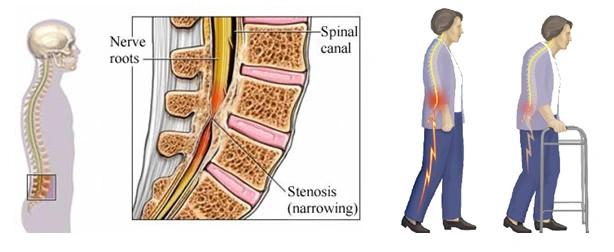
Lumbar decompression surgery is used to treat compressed nerves in the lower (lumbar) spine. The surgery aims to treat symptoms caused by pressure on the nerves in the spine and is only recommended when non-surgical treatments fail to help.
Lumbar decompression surgery is often used to treat:
- Spinal Stenosis (shrinking of the spinal column resulting in pressure on the nerves in spine)
- Slipped disc and Sciatica (an underlying nerve under pressure due to damaged spinal disc)
- Spinal injuries (severe injuries causing fracture or swelling of tissue)
- Metastatic spinal cord compression (cancer in one part of the body when spreads into the spine causing pressure on the spinal cord)
What happens during surgery?
Lumbar decompression surgery may involve one or more of the following procedures:
- Laminectomy: A bone section may be removed from the spinal bones to relieve pressure on the affected nerve.
- Discectomy: The damaged disc may be removed to relieve pressure on a nerve.
- Spinal fusion: Two or more vertebrae may be joined together with a bone section to stabilise the spine.
There are many different treatments to relieve pressure on the spine:
1) Pedicle Screw Fixation
- Provides stability and support to the spine after surgery and keeps bone grafts intact during healing.
- Metal rods connect spinal segments; pedicle screws provide anchor points.
- Once the bone graft fuses, rods and screws may be removed.
2) PLIF, ALIF and TLIF Procedures
These are fusion surgeries where two or more vertebrae are joined or fused together.
PLIF (Posterior Lumbar Interbody Fusion): Fusion through an incision in the patient’s back.

- Pre-operative planning using MRI and CAT scans.
- Disc space prepared via 3–6 inch incision on back.
- Bone graft or implant inserted to promote fusion, rods/screws may be added for stability.
ALIF (Anterior Lumbar Interbody Fusion)
This procedure is similar to PLIF but performed from the front of the body.

- 3–5 inch incision made on lower abdomen or side.
- Mini open ALIF approach uses a small incision to fuse L5–S1 disc space.
- Disc material removed after abdominal access.
- Bone graft, cages, rods, or screws inserted for stabilization.
TLIF (Transforaminal Lumbar Interbody Fusion): Approach from the side of the spinal canal via midline incision.
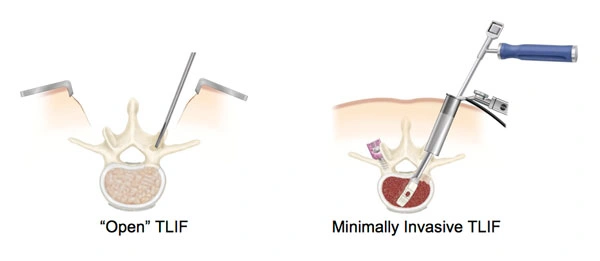
- Minimizes nerve manipulation and trauma.
- Allows minimal access and endoscopic techniques.
- Bone graft, cages, screws, or rods facilitate fusion and stability.
3) Microdiscectomy
Removes disc material pressing on spinal nerves; minimally invasive and relieves sciatica pain.
4) MISS (Minimally Invasive Spine Surgery)
Used for back/neck pain caused by spinal disorders with less tissue damage. Treats:
- Degenerative disc disease
- Herniated discs
- Spinal stenosis
MISS minimizes soft tissue damage and supports decompression and stabilization goals.
5) Foraminotomy Procedure
Relieves nerve compression in the neural foramina (spinal openings) by removing obstructions.
6) Vertebroplasty
Injects bone cement into cracked or broken vertebrae (often due to osteoporosis) to stabilize and relieve pain.
7) Kyphoplasty
Similar to vertebroplasty but uses balloons to create space before injecting bone cement, correcting deformity and restoring height.
8) Recovery
Recovery depends on surgery complexity. Most patients walk unassisted within a day and are discharged in 1–4 days. Avoid strenuous activity for 4–6 weeks.
Risks Involved
Lumbar decompression surgery is effective but carries risks:
- Infection, CSF leak, implant failure
- Deep vein thrombosis (DVT)
- Heart-related complications (e.g., myocardial infarction)
- Rare cases of nerve or spinal cord damage causing numbness or weakness