
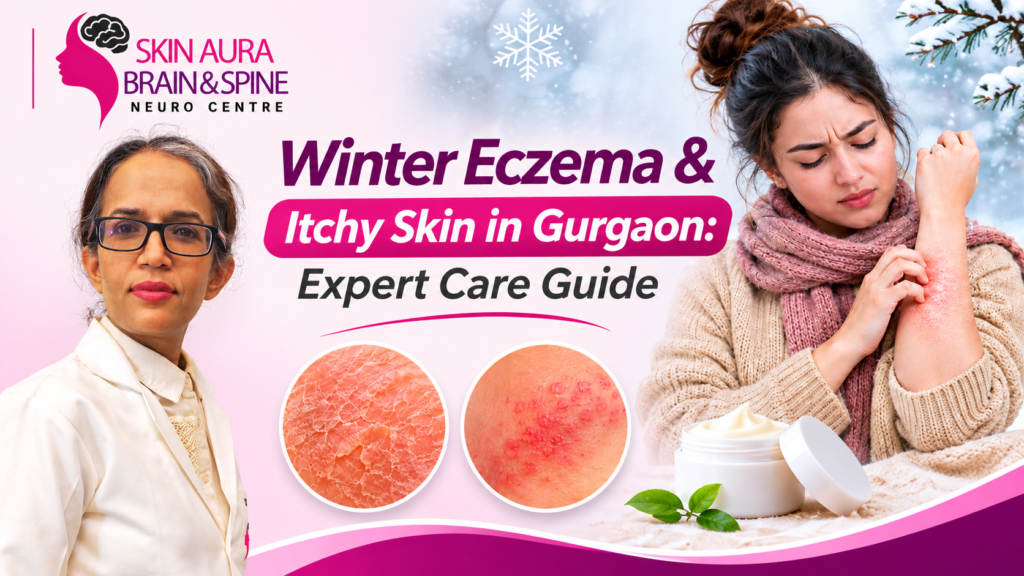
Winter Itch, Dry Skin or Eczema? Get the Right Care in Gurgaon & Delhi NCR
Dry air, hot showers, room heaters and polluted winter air can push sensitive skin into painful flare-ups. Here is how to tell ordinary dryness from eczema, what really helps, and when to see a dermatologist at Skin Aura Brain & Spine Neuro Centre.
Quick Summary: Winter Skin in Gurgaon at a Glance
- Dry skin feels tight and flaky; eczema is red, intensely itchy, inflamed and may crack or ooze.
- Delhi NCR winters combine low humidity, heating, hard water and pollution, a tough mix for the skin barrier.
- Moisturise within three minutes of a lukewarm bath, and avoid fragranced soaps.
- Persistent itching, sleep loss or cracked, weeping skin needs a dermatologist, not another cream.
- Dr. Jasdeep Kaur consults at Qutub Plaza, South Point Mall and the DLF Phase 4 clinic, Gurgaon.
Every year, as the first cold mornings arrive, clinics across Gurgaon and Delhi NCR see the same story: rough hands, scaly shins, an itch that gets worse at night and a moisturiser that no longer seems to work. Many people assume it is “just winter dryness” and keep layering lotion. For some, that is true. For others, the real problem is winter eczema, a chronic inflammatory condition that needs a proper diagnosis and a structured plan.
This guide explains why winter hits skin so hard in our region, how to tell the difference between dry skin and eczema, what a dermatologist can do, and what you can safely do at home. If you are searching for winter eczema treatment in Gurgaon, read on, and use the locations section to find the clinic nearest to you.
Why Delhi NCR Winters Are So Hard on Your Skin
Your skin has a thin protective layer, the skin barrier, that locks in water and keeps irritants out. When humidity falls, that barrier loses moisture faster than the body can replace it. Several local factors make this worse across Gurgaon, Delhi and the wider NCR:
Dry, Cold Air
Winter air holds very little moisture, so water evaporates from the skin surface, leaving it tight, rough and flaky.
Heaters & Blowers
Room heaters and blowers dry indoor air further. Sleeping in a closed, heated room can leave skin parched by morning.
Hot Showers
A steaming bath feels wonderful but strips natural oils. Long, hot showers are among the most common triggers we see.
Hard Water & Pollution
Many NCR homes receive hard water, and winter air quality often dips. Both can irritate a weakened skin barrier.
Dry Skin vs Eczema vs Other Winter Itch: How to Tell
Not every itch is eczema, and not every patch of dryness is harmless. Use the table below as a rough guide, but remember that only an examination can confirm the cause.
| Feature | Winter Dry Skin (Xerosis) | Eczema (Atopic Dermatitis) |
|---|---|---|
| Look | Fine flaking, dull, tight skin | Red or darker, inflamed, rough patches; may crack, ooze or crust |
| Itch | Mild to moderate | Intense, often worse at night, disturbs sleep |
| Common areas | Shins, arms, hands, lips | Elbow and knee folds, neck, eyelids, hands, behind the ears |
| Response to moisturiser | Improves within days | Temporary relief, then returns |
| Pattern | Seasonal | Repeated flare-ups, often with a family history of allergy, asthma or hay fever |
Could It Be Something Else?
Psoriasis, fungal infections, contact dermatitis and scabies can all look like “winter itch”. If a patch is well-defined and scaly, keeps spreading, or does not respond to basic care, it is worth having it examined. Treating the wrong condition only delays relief.
Common Signs of Winter Eczema
- Persistent itching that interrupts sleep or daily work
- Red, brownish or grey patches, depending on your skin tone
- Thickened, leathery skin from repeated scratching
- Cracks on fingertips, palms and heels that sting or bleed
- Small fluid-filled bumps that may ooze and crust
- Burning or stinging when you apply certain creams or soaps
What Triggers Eczema Flare-Ups in Winter?
Eczema is driven by a sensitive skin barrier and an overactive immune response. Winter does not create eczema out of nothing, but it lowers the threshold for a flare. Typical triggers include:
- Frequent hot bathing and harsh, foaming cleansers.
- Wool and rough synthetics worn directly on the skin, a very common issue with winter woollens.
- Fragranced products such as perfumed lotions, body washes and detergents.
- Dust and pollution that settle on skin and clothing.
- Stress and poor sleep, which can intensify the itch-scratch cycle.
- Frequent hand washing and sanitiser use, which strips the hands further.
How a Dermatologist Treats Winter Eczema and Severe Dry Skin
The best results come from treating the cause, not just the symptom. At Skin Aura Brain & Spine Neuro Centre, Dr. Jasdeep Kaur, a senior consultant dermatologist and cosmetologist, begins with a careful history and skin examination to confirm whether you have simple dryness, eczema or another skin condition. Based on that diagnosis, a personalised plan may include:
1. Barrier Repair
Dermatologist-recommended emollients and a gentle cleansing routine to restore the skin’s protective layer.
2. Calming Inflammation
Prescription topical medicines for active flares, used for the right duration under medical guidance.
3. Itch & Sleep Control
When night-time itching is severe, suitable medicines may be advised to break the scratch cycle.
4. Infection Care
Cracked, scratched skin can become infected. Early treatment prevents complications.
Eczema is a long-term condition with no instant cure, but with the right plan most people achieve good control, fewer flare-ups and better sleep. Prescription creams, including topical corticosteroids, should only be used as advised, because the strength, body site and duration all matter.
Your Winter Skin Routine: Dermatologist-Style Home Care
7 Simple Steps for Soft, Calm Skin
- Bathe smart: Use lukewarm water for five to ten minutes. Avoid very hot showers.
- Cleanse gently: Choose a mild, fragrance-free cleanser and skip scrubs and loofahs.
- Moisturise fast: Pat dry and apply a thick, fragrance-free moisturiser within three minutes while skin is still damp.
- Repeat often: Reapply on hands after every wash and on legs and arms morning and night.
- Add humidity: A humidifier or a bowl of water near the heater can ease indoor dryness.
- Dress right: Wear soft cotton next to the skin, with woollens only as an outer layer. Wash new clothes before wearing.
- Protect your skin: Use sunscreen even in winter, and cover hands in cold, dusty weather.
Keep fingernails short and clean, since scratching damages the barrier and invites infection. A cool compress can ease an intense itch in the moment. Drinking enough water and eating a balanced diet also support overall skin health, although no food or drink replaces proper skin care.
When Should You See a Dermatologist?
Try sensible home care for one to two weeks. Book an appointment sooner if you notice any of the following:
- Itching that keeps you awake or affects work and school
- Skin that is cracked, bleeding, weeping or covered with yellow crusts
- Painful, warm or swollen areas, or fever, which may signal infection
- Patches on the face, eyelids or genitals
- No improvement with regular moisturising, or repeated flares every winter
- A baby or child with persistent rashes
Winter Eczema in Children and Older Adults
Children are especially prone to eczema, and infants may develop itchy, dry cheeks and scalp. Their skin is delicate, so medicines and creams should be chosen by a doctor. Dr. Jasdeep Kaur also treats paediatric skin concerns. Older adults naturally produce less skin oil, so winter itching can appear even without a history of eczema. Gentle care and early review help prevent painful cracking.
Visit Skin Aura at Three Convenient Locations in Gurgaon
Whether you live in DLF Phases 1 to 5, Sushant Lok, Golf Course Road, MG Road, Sohna Road or nearby parts of Delhi NCR, you can reach an expert dermatologist close to home. OPD is open daily from 10:00 AM to 7:00 PM.
Qutub Plaza, DLF Phase 1
423, 4th Floor, Qutub Plaza, Qutub Plaza Road, DLF Phase-1, Sector 26A, Gurugram, Haryana 122002
Appointments Available
South Point Mall, Sector 53
SPO-101A, First Floor, South Point Mall, DLF Phase 5, Sector 53, Gurugram, Haryana 122011
Appointments available from 1 December 2026.
Skin Aura, DLF Phase 4
House No. 7311, Basement & Ground Floor, near HUDA City Centre Metro, DLF Phase IV, Gurugram, Haryana
Dr. Jasdeep Kaur – OPD 10 AM to 7 PM daily.
Looking for other skin and cosmetic care? Explore our thread lift treatment in Gurgaon, read about Ozempic face and loose skin treatment, or visit the Sab Clinic home page for all our dermatology, hair and brain & spine services.
Frequently Asked Questions: Winter Eczema and Dry Skin in Gurgaon
1. How do I know if my winter itching is eczema or just dry skin?
Dry skin is usually flaky and tight, and it improves with regular moisturising. Eczema is typically red or darker, inflamed and intensely itchy, and it tends to return in repeated flare-ups. If itching disturbs your sleep or patches keep coming back, a dermatologist can confirm the cause.
2. Which is the best dermatologist for eczema in Gurgaon?
Choose a qualified dermatologist who examines your skin, identifies triggers and gives a long-term plan. Dr. Jasdeep Kaur at Skin Aura Brain & Spine Neuro Centre is a senior consultant dermatologist and cosmetologist who treats eczema, dry skin and other common skin conditions.
3. Can eczema be cured permanently?
Eczema is a chronic condition, so it is usually managed rather than cured. With barrier repair, trigger control and appropriate medicines, many people enjoy long calm periods and far fewer flare-ups.
4. Why does my skin itch more at night in winter?
Skin loses more water at night, body temperature shifts, and there are fewer distractions, so itch feels stronger. Moisturising before bed, keeping the bedroom comfortably humid and wearing soft cotton can help. Severe night itching deserves medical review.
5. Is it safe to use steroid cream for winter eczema?
Prescription topical steroids are an important and effective treatment when used correctly. Strength, site and duration matter, so use them only as advised by your dermatologist, especially on the face, folds and children.
6. How often should I moisturise in winter?
At least twice a day, and always within a few minutes of bathing. Reapply to hands after each wash. Use a thick, fragrance-free cream or ointment rather than a thin, perfumed lotion.
7. Do I need to see a doctor for dry skin in winter?
Mild dryness often settles with home care. See a doctor if the skin cracks or bleeds, shows signs of infection, keeps itching despite regular moisturising or flares up every winter.
8. Where can I get winter eczema treatment in Gurgaon and Delhi NCR?
You can consult Dr. Jasdeep Kaur at Skin Aura in DLF Phase 4, at Qutub Plaza in DLF Phase 1 (appointments from 15 November 2026) or at South Point Mall in Sector 53 (appointments from 1 December 2026). OPD runs daily from 10 AM to 7 PM.
Don’t Let Winter Itch Ruin Your Sleep
Book a consultation with Dr. Jasdeep Kaur and get a skin plan that fits your skin, your home and your Delhi NCR winter.
Trusted Medical References
For further reading, see the American Academy of Dermatology: Eczema, the NHS guide to atopic eczema and the National Eczema Association.
Disclaimer: This article is for general education and does not replace a personal medical consultation. Please consult a qualified dermatologist for diagnosis and treatment.