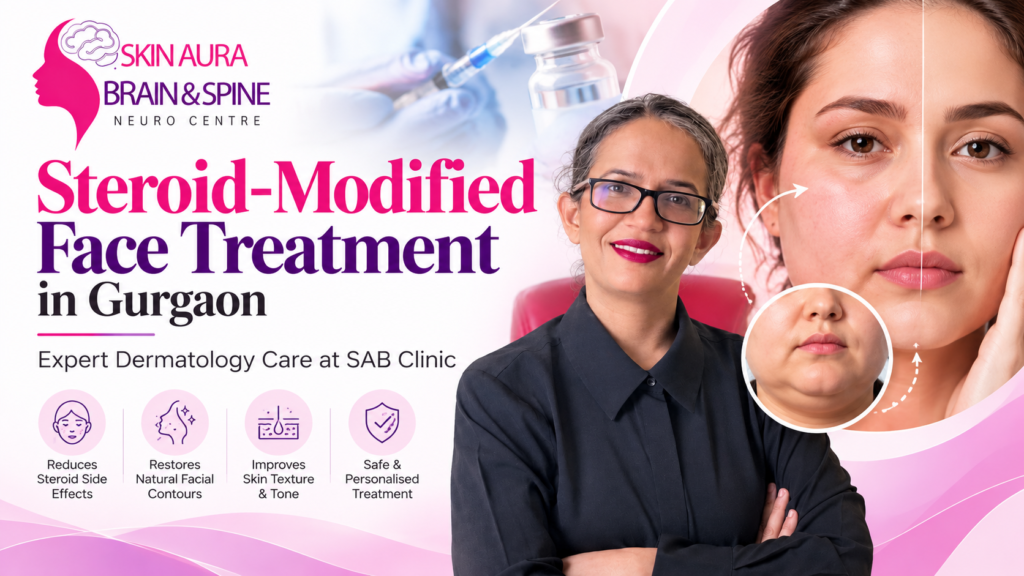
Agar aap ne kabhi chemist ke kehne par ya “fairness cream” samajh kar koi tube chehre par lambe time tak lagayi hai, aur ab skin patli, laal, jalan wali ya pimples wali ho gayi hai, to ye steroid modified face ho sakta hai.
Sabse zaroori baat: cream achanak band mat kijiye aur naya experiment mat kijiye. Saari creams le kar dermatologist ke paas jaiye. Sahi diagnosis aur supervised treatment se skin dheere-dheere wapas theek hoti hai.
Almost everyone has a story about a cream that “worked like magic”. A rash that vanished overnight, a pimple that dried in a day, a dull face that looked lighter within a week. For many people in Gurgaon and across Delhi NCR, that magic came from a potent steroid hidden inside an over-the-counter cream. The relief is real, but so is the price: weeks or months later the skin turns thin, red, itchy and unpredictable, and the very cream that helped begins to make things worse.
Dermatologists now have a name for this pattern: steroid modified face, also called topical steroid damaged face. In this guide, Dr. Jasdeep Kaur Malhotra’s team at SAB Clinic explains what it is, why it is becoming so common, how to spot it, and what safe treatment looks like.
What Is Steroid Modified Face?
Topical corticosteroids are genuinely useful medicines. Prescribed in the right strength, for the right condition and for a limited time, they calm eczema, allergic rashes, psoriasis and many other inflammatory problems. The trouble starts when a strong steroid is used on the face for weeks, months or even years, often without a diagnosis, and often in a “mixed” cream along with an antifungal or antibiotic.
Facial skin is thin and absorbs medicines far more readily than skin on the arms or legs. With repeated use, a steroid can weaken the skin’s structure and barrier, dilate small blood vessels and disturb the balance of the skin’s natural flora. The result is a face that looks and feels very different from before: that is the “modification” in steroid modified face.
Why Is Steroid Modified Face Rising in India and Delhi NCR?
Indian dermatologists have been warning about this for years, and recent reports describe it showing up in clinics from teenagers to working professionals. Several everyday habits feed the problem:
- Over-the-counter access: Many steroid-containing creams can be bought at a chemist without a prescription, and pharmacists or non-specialists are often the first source of advice.
- “Fairness” and glow creams: Some unregulated or unbranded creams that promise rapid lightening contain potent steroids. The face looks brighter for a while because the steroid thins the skin and temporarily suppresses pigment.
- Triple-combination creams: Steroid + antifungal + antibiotic tubes are sold for almost any rash. They treat nothing properly and can make fungal infections harder to diagnose.
- Pollution and winter dryness: Delhi NCR’s air quality and dry winter air irritate the skin barrier, pushing people to grab a quick-relief cream again and again.
- Wedding and festival deadlines: The pressure to look clear and bright within days makes “instant result” products very tempting at this time of year.
These figures come from a multicentre study of dermatology outpatients published in the Indian Journal of Dermatology, Venereology and Leprology (view the abstract on PubMed). The study also found that a large share of the prescriptions behind this use came from non-dermatologists, which shows how easily the problem begins with well-meaning but incomplete advice.
Steroid Modified Face: Signs and Symptoms to Watch For
Steroid-modified face does not look the same in everyone. Early changes are easy to ignore, so it helps to know the whole spectrum.
| Stage | What you may notice |
|---|---|
| Early | Quick relief followed by the problem returning faster each time; the face looks unusually bright, smooth or “tight”; skin feels dependent on the cream. |
| Developing | Persistent redness and flushing, burning or stinging with water or sunlight, small acne-like bumps (often around the mouth, cheeks and forehead), increased facial hair growth. |
| Advanced | Thin, shiny, fragile skin; visible tiny blood vessels; dark patches or uneven pigmentation; stretch-mark-like lines; easy bruising; severe rebound flares on stopping the cream. |
Red, burning face
Constant warmth, flushing and a stinging feeling after washing or stepping into sunlight.
Acne-like eruptions
Tiny bumps and pimples that do not respond to usual acne treatment and often worsen with more cream.
Thin, fragile skin
Skin that looks shiny, tears or bruises easily and shows tiny red vessels.
Cream dependence
The rash or redness returns as soon as the cream is skipped, so you keep reapplying.
Not Just the Face: Modified Ringworm and Stretch Marks
The same misuse shows up elsewhere. Steroid-containing combination creams applied to ringworm can change how the rash looks (a pattern doctors call modified tinea), making it larger, itchier and more widespread while hiding its classic shape. If you have a stubborn rash in the groin, thighs or body folds that keeps spreading despite creams, read our guide on when to see a dermatologist for a fungal infection.
Repeated steroid use on the body can also cause wide, stretch-mark-like lines in the skin folds, which can be difficult to reverse. For existing marks, our stretch marks treatment page explains the options.
Why You Should Not Simply Stop the Cream Overnight
Important: If you have used a steroid cream on your face for a long time, stopping it suddenly on your own can trigger a strong rebound: intense redness, burning, swelling and breakouts. This is sometimes described as steroid withdrawal or the “red face” reaction. It is frightening, and it is the most common reason people go back to the cream.
Hinglish mein: Lambe time se lagayi gayi cream ko ek dum band karna bhi risky ho sakta hai. Pehle dermatologist se plan banwaiye.
How a Dermatologist Diagnoses Steroid Modified Face
Diagnosis begins with a detailed conversation. Your doctor will ask what you applied, for how long, who advised it and how your skin behaved when you stopped or skipped doses. Please bring every tube, jar and sachet you have used, including “natural” or salon creams. The skin is then examined for thinning, vessels, pigment change and the pattern of eruptions. In some cases a simple test such as a skin scraping is used to rule out a hidden fungal infection, and a skin sample may be taken if the picture is unclear.
This step matters because several conditions look alike. Rosacea, seborrhoeic dermatitis, true acne, melasma and eczema can all appear on a steroid-affected face, and treating the wrong one prolongs the problem. For a sense of what to expect at the first visit, see what happens during your first dermatologist visit in Gurgaon.
How Steroid Modified Face Is Treated
There is no single formula, because the plan depends on how long the steroid was used, its strength and what the skin looks like today. In general, a structured approach has these parts:
- Stop the trigger safely. The doctor decides whether to taper the cream gradually, switch to a milder option or stop it, depending on your case.
- Calm the skin with non-steroidal options. Prescription anti-inflammatory creams that do not thin the skin may be used, along with medicines for acne-like eruptions or associated infection when needed.
- Rebuild the barrier. Fragrance-free moisturisers, gentle cleansing and strict sun protection give the skin a chance to recover.
- Manage the rebound phase. Cool compresses, simple skincare and regular follow-ups help you get through the flare without returning to the old cream.
- Treat the after-effects once the skin is stable. Pigmentation, marks and scars can be addressed later with procedures chosen for sensitive skin.
Recovery is usually gradual, often taking weeks to months, and longer after prolonged use. Patience and regular follow-up make the biggest difference. Please do not start peels, lasers or strong actives while the skin is inflamed; they can worsen sensitivity.
Treating the after-effects
Once the barrier has recovered, your dermatologist can plan corrective care for what the steroid left behind: uneven tone through our pigmentation treatment, marks and texture changes through acne and scar care, and overall glow through gentle skin rejuvenation and brightening. Sequence and timing are decided case by case.
Skincare During Recovery: Do’s and Don’ts
| Do | Don’t |
|---|---|
| Use a gentle, fragrance-free cleanser and moisturiser | Do not apply random creams, home remedies or “glow” products on inflamed skin |
| Apply a broad-spectrum sunscreen daily, even in Delhi’s winter haze | Do not scrub, exfoliate or use strong acids and retinoids unless advised |
| Carry all your old creams to the consultation | Do not restart the old cream when the rebound flare appears |
| Keep a short photo diary to track progress | Do not take chemist or friend advice for your face rash |
| Follow the review schedule your doctor sets | Do not schedule facials, peels or lasers before an important event while skin is reactive |
Preventing Steroid Modified Face
- Use steroid creams only when a doctor has prescribed them, for the stated area and duration.
- Never use a steroid cream on the face as a fairness, glow or anti-pimple product.
- Read the label and ingredient list. Names such as clobetasol, betamethasone and mometasone indicate a steroid.
- Be wary of any unbranded cream that lightens skin quickly or gives dramatic relief.
- Do not reuse an old prescription for a new rash. Rashes that look similar can have very different causes.
- If a cream suddenly stops working or the skin worsens when you skip it, treat that as a warning sign and see a dermatologist.
When Should You See a Dermatologist?
Book a consultation if you have used any cream continuously on your face for more than a couple of weeks, if your skin is red, burning, thinning or breaking out, or if a rash keeps returning the moment you stop treatment. Early assessment shortens recovery. Not sure whether your symptoms need a specialist? Our article on 10 signs you should visit a dermatologist instead of self-treating can help you decide.
Steroid Modified Face Treatment in Gurgaon: Meet Your Dermatologist

Dr. Jasdeep Kaur Malhotra
Senior Consultant, Dermatology & Venereology (MBBS, DDVL, FAGE) | 15+ years of experience
Dr. Jasdeep Kaur treats a wide range of skin, hair and nail conditions and is also a paediatric dermatologist and aesthetician. View full profile
For steroid modified face treatment in Gurgaon, the focus at SAB Clinic is on finding out what is really happening in your skin before any treatment begins. You will get a clear explanation, a realistic timeline and an honest conservative plan, without unnecessary procedures.
Frequently Asked Questions
What is steroid modified face?
It is a group of skin changes caused by prolonged or unsupervised use of steroid creams on the face, including thin shiny skin, redness, visible blood vessels, acne-like bumps, pigmentation and extreme sensitivity.
Hinglish: Chehre par lambe samay tak steroid cream lagane se skin patli, laal aur sensitive ho jati hai. Ise steroid modified face kehte hain.
Can I just stop the cream suddenly?
Stopping on your own after long use can cause a rebound flare with burning, redness and swelling. A dermatologist will plan a supervised reduction or a switch to non-steroidal options.
Hinglish: Ek dum band karne se jalan aur redness badh sakti hai. Doctor ki salah se hi dheere-dheere band karein.
How do I know if my fairness cream contains a steroid?
It is hard to tell by looking. Check the ingredient list for steroid names such as clobetasol, betamethasone or mometasone, and be cautious about unbranded creams that lighten quickly but leave your skin worse when you stop. Bring every cream to your dermatologist.
Hinglish: Jo cream bahut jaldi gora kar de aur band karne par skin kharab ho jaye, usse shak ki nazar se dekhein aur doctor ko dikhayein.
Is steroid modified face reversible?
Many changes, such as redness, sensitivity and acne-like eruptions, improve with correct treatment, though recovery can take weeks to months. Some changes like stretch-mark-like lines may be harder to reverse, so early diagnosis is important.
Hinglish: Zyada tar problems sahi ilaaj se theek hoti hain, par time lagta hai. Jitna jaldi doctor ko dikhayenge, utna behtar.
Are steroid creams always bad?
No. They are valuable medicines for conditions like eczema, psoriasis and allergic rashes when prescribed in the right strength, on the right area and for the right duration. The harm comes from misuse, especially on the face and skin folds.
Hinglish: Steroid cream galat nahi hai, galat use galat hai. Doctor ki prescription par ye bahut kaam ki dawa hai.
Can I get a facial or peel while my skin is recovering?
Usually not until the skin barrier has settled. Facials, peels and lasers can aggravate inflamed, thin skin. Your dermatologist will advise when it is safe to begin cosmetic treatments.
Hinglish: Jab tak skin shant na ho, facial ya peel na karwayein. Doctor se pooch kar hi agla step lein.
Where can I get treatment in Gurgaon?
You can consult Dr. Jasdeep Kaur Malhotra at SAB Clinic (Skin Aura Brain & Spine Neuro Centre), DLF Phase 4, Gurugram. Call or WhatsApp +91-8586844718 to book.
Hinglish: Gurgaon mein appointment ke liye SAB Clinic, DLF Phase 4 par call ya WhatsApp karein: +91-8586844718.
Skin red, thin or burning after using creams?
Get it assessed early. Bring all your creams and let our dermatologist build a safe recovery plan.
Call +91 85868 44718
Book Appointment
H.N. 7311 (GF & Basement), Opp. Supermart-2, DLF Phase 4, Gurugram 122002
Mon-Sat: 10:30 AM-12:30 PM & 6:00-7:30 PM | Sun: 10:00 AM-2:00 PM
Medical disclaimer: This article is for general education and is not a substitute for personal medical advice, diagnosis or treatment. Treatment decisions depend on individual examination. Please consult a qualified dermatologist before starting, stopping or changing any medicine.