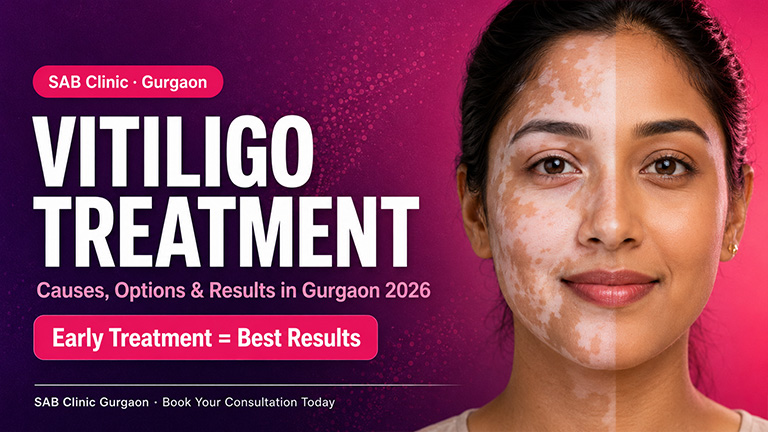
Vitiligo – the condition causing white patches to appear on the skin – affects millions of people across India, and patients seeking effective, evidence-based vitiligo treatment at a skin clinic in Gurgaon are increasingly finding that modern dermatology has far more to offer than it did even a decade ago. While vitiligo cannot always be permanently cured, significant repigmentation and effective stabilisation are achievable with the right combination of treatments – especially when care begins early.
At SAB Clinic – a trusted skin clinic in Gurgaon – this guide explains what vitiligo is, what causes it, and what the most effective current treatment options are for patients across Gurgaon, DLF, Golf Course Road, and South Delhi.
What is vitiligo?
Vitiligo is a chronic autoimmune skin condition in which the immune system mistakenly attacks and destroys melanocytes – the cells responsible for producing the pigment melanin that gives skin its colour. When melanocytes in a particular area of skin are destroyed, that area loses its pigment and appears as a white or depigmented patch.
Vitiligo can affect any area of the body, including the face, hands, feet, genitals, and hair. It can occur at any age but most commonly appears before the age of 30. Vitiligo is not contagious, not caused by any infection, and poses no direct physical health risk – but its psychological and social impact is profound, particularly in India where skin appearance carries significant cultural importance.
Types of vitiligo
Generalised vitiligo is the most common form – patches appear symmetrically on multiple areas of both sides of the body and may spread progressively over time.
Segmental vitiligo affects only one side or segment of the body, tends to progress rapidly for 1–2 years then stabilise, and responds particularly well to surgical repigmentation treatments.
Focal vitiligo involves one or a few patches in a small area that do not spread significantly.
Universal vitiligo affects more than 80% of the body surface – the rarest and most extensive form.
Accurate classification of vitiligo type is essential before planning treatment at SAB Clinic Gurgaon – because different types respond differently to available therapies.
What causes vitiligo?
Vitiligo is an autoimmune condition – the immune system targets the body’s own melanocytes. The exact trigger is not fully understood, but contributing factors include genetic predisposition – vitiligo runs in families, emotional stress or physical trauma that may trigger or worsen the condition, and association with other autoimmune conditions including thyroid disease (Hashimoto’s thyroiditis, Graves’ disease), type 1 diabetes, and rheumatoid arthritis. SAB Clinic Gurgaon routinely screens vitiligo patients for associated thyroid and autoimmune conditions as part of the initial assessment.
Vitiligo treatment options at SAB Clinic Gurgaon
Topical corticosteroids are the first-line treatment for localised, active vitiligo – particularly in children and patients with early-stage disease. Potent topical steroids applied consistently to depigmented patches can stimulate repigmentation in many patients, especially when the condition is caught early. They are used cyclically to avoid long-term side effects.
Topical calcineurin inhibitors (tacrolimus, pimecrolimus) are non-steroidal anti-inflammatory topicals that suppress the localised immune attack on melanocytes. They are particularly valuable for vitiligo on the face, neck, and sensitive areas where long-term steroid use is not advisable.
Narrowband UVB phototherapy is the most evidence-based, effective, and widely used treatment for widespread vitiligo at a skin clinic in Gurgaon. Narrowband UVB (NB-UVB) light therapy stimulates the melanocytes that remain in the skin to proliferate and repigment the affected patches. Treatments are administered 2–3 times per week. Most patients require 48–72 sessions for meaningful repigmentation. NB-UVB is safe for all age groups including children, pregnant women, and patients on most medications.
Excimer laser (308nm) – For localised stable vitiligo patches, the targeted excimer laser delivers concentrated NB-UVB energy precisely to affected areas – producing faster repigmentation with fewer total sessions than whole-body phototherapy. SAB Clinic Gurgaon uses excimer laser for focal and segmental vitiligo patches that have not responded adequately to topical therapy alone.
Oral and systemic treatments – For rapidly spreading active vitiligo, short courses of oral corticosteroids or newer systemic immunomodulatory treatments help halt disease progression before repigmentation therapy is initiated. Emerging treatments including JAK inhibitors represent a significant advance in vitiligo management and are increasingly available at specialist skin clinics in Gurgaon.
Surgical repigmentation – For stable vitiligo – patches that have not changed for at least 12 months – surgical repigmentation offers the possibility of permanent colour restoration. Techniques include suction blister epidermal grafting, split-thickness skin grafting, and melanocyte transplantation. Surgical repigmentation is particularly effective for segmental vitiligo and produces excellent, durable results in carefully selected patients at SAB Clinic Gurgaon.
Camouflage and depigmentation – For patients with extensive vitiligo who are not candidates for or do not wish repigmentation therapy, medical-grade camouflage products provide cosmetic coverage. For universal vitiligo, controlled depigmentation of remaining normally pigmented skin creates a uniform skin tone using topical monobenzone.
Before and after vitiligo treatment
Repigmentation in vitiligo typically begins as small brown dots appearing within white patches – these are follicular repigmentation islands where surviving melanocytes from hair follicles begin repopulating the patch. Over months of consistent treatment, these islands expand and merge, gradually restoring normal skin colour across the patch. The face, neck, and trunk typically repigment fastest. Hands, feet, and lips are the most resistant areas. At SAB Clinic Gurgaon, progress is tracked with clinical photography at every follow-up visit.
Frequently asked questions
Can vitiligo be cured permanently at a skin clinic in Gurgaon?
While a permanent cure is not guaranteed, significant and lasting repigmentation is achievable in many patients – particularly with early treatment and consistent therapy. Segmental vitiligo treated surgically after stabilisation has the highest rates of permanent, durable repigmentation.
Is vitiligo treatment painful?
Topical treatments and phototherapy are painless. The excimer laser causes mild warmth during treatment. Surgical procedures are performed under local anaesthesia.
How long does vitiligo treatment take to show results?
Repigmentation is a slow process. Most patients notice early changes – small repigmentation dots – after 2–3 months of consistent phototherapy or topical treatment. Meaningful coverage of patches typically requires 6–18 months of treatment.
Is vitiligo associated with other health conditions?
Yes. Vitiligo is associated with autoimmune thyroid conditions, type 1 diabetes, and other autoimmune disorders. SAB Clinic Gurgaon routinely screens new vitiligo patients for these associated conditions as part of initial assessment.
Can children with vitiligo be treated at SAB Clinic Gurgaon?
Yes. SAB Clinic Gurgaon manages vitiligo across all age groups. Narrowband UVB phototherapy and topical treatments are safe and effective for children. Treatment protocols are adjusted appropriately for paediatric patients.
Book your vitiligo consultation at SAB Clinic – the trusted skin clinic in Gurgaon
Vitiligo is a treatable condition – and the earlier treatment begins, the better the outcomes. If you or a family member is experiencing white patches on the skin, book a consultation at SAB Clinic Gurgaon for a comprehensive assessment and a personalised, evidence-based treatment plan. Serving patients from DLF, Golf Course Road, South Delhi, Sohna Road, Faridabad, and across NCR.