
Dr. Jasdeep Kaur Malhotra
MBBS, Diploma in Dermatology, Venereology & Leprosy (DDVL)
15+ Years of Experience in Skin & Cyst Treatment
View Doctor Profile
Ganglion cyst treatment is something most patients start searching for the moment they notice a small, soft bump on a finger, wrist, or the back of the hand. It often grows slowly and does not go away on its own. In most such cases, this swelling is a ganglion cyst — sometimes called a “synovium finger cyst” because it develops from the synovial lining that surrounds joints and tendons. At Skin Aura Brain & Spine Neuro Centre in Gurgaon, our dermatology team regularly evaluates and provides ganglion cyst treatment for patients across Gurugram, DLF Phase 4, and greater Delhi NCR. If you are searching for trusted ganglion cyst treatment in Gurgaon or a finger cyst doctor near me in Delhi NCR, this guide explains what a synovium finger cyst is, why it forms, how it is diagnosed, and which ganglion cyst treatment actually works.
What Is a Synovium Finger Cyst (Ganglion Cyst)?
A ganglion cyst is a benign, fluid-filled sac. It forms along a tendon sheath or joint capsule. It is most commonly seen on the back of the wrist, the base of a finger, or near the end joint of a finger, where it is often called a mucous cyst. The sac is lined by tissue similar to the synovium — the thin membrane that lubricates joints and tendons. It fills with a thick, clear, jelly-like fluid known as synovial fluid. This is why the swelling is often called a “synovium cyst” or “synovial cyst” in everyday language, even though dermatologists and orthopedic specialists use the medical term ganglion cyst.
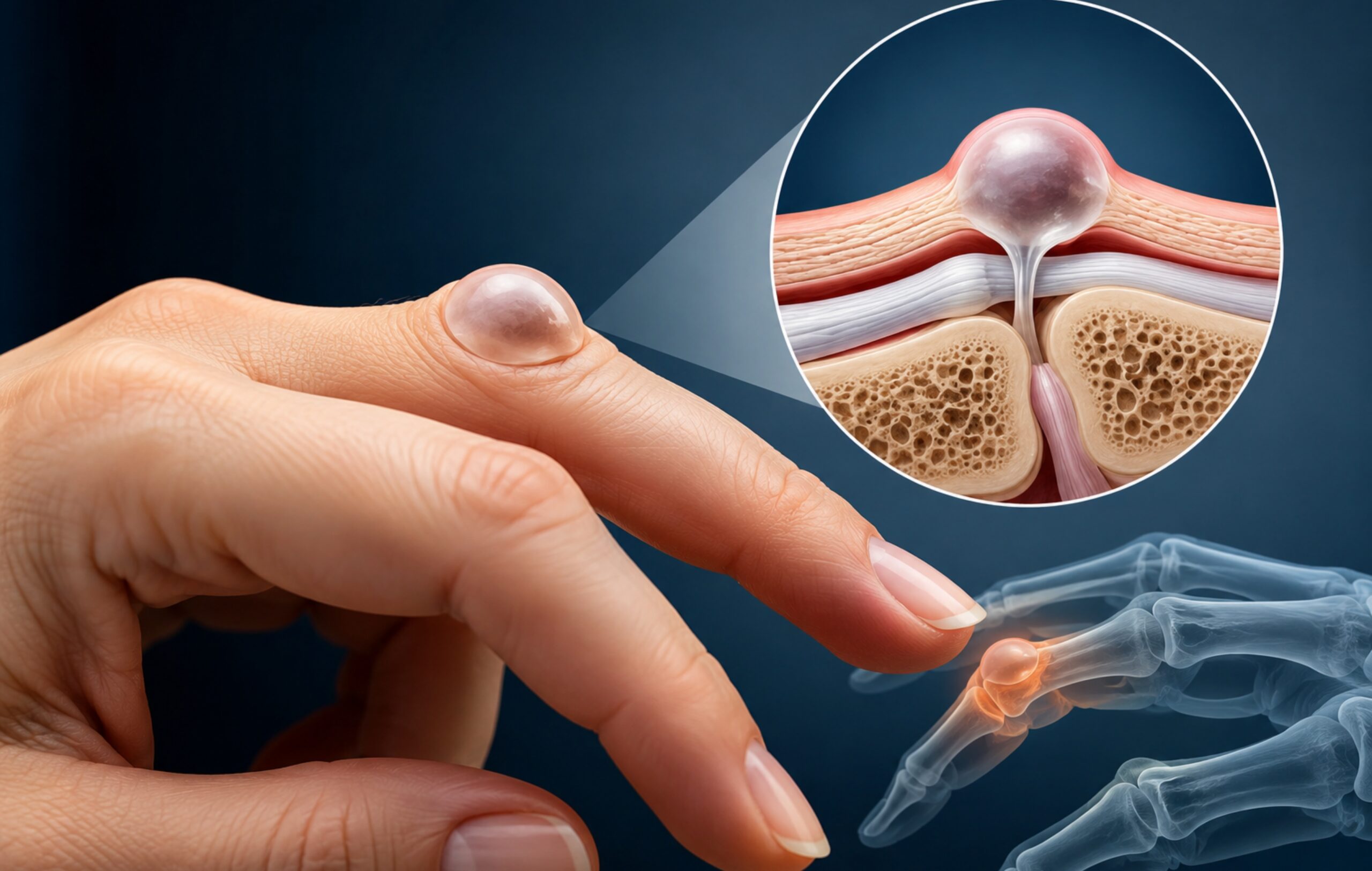
These cysts are extremely common. They can appear suddenly or grow gradually over weeks or months. Size may fluctuate, and they are almost always non-cancerous. A ganglion cyst on the finger is rarely dangerous. But it can be uncomfortable, cosmetically bothersome, or occasionally restrict finger movement. This is why many patients in Gurgaon and across Delhi NCR choose our dedicated Cyst & Lipoma Removal service for proper ganglion cyst treatment from a qualified dermatologist rather than leave it untreated indefinitely.
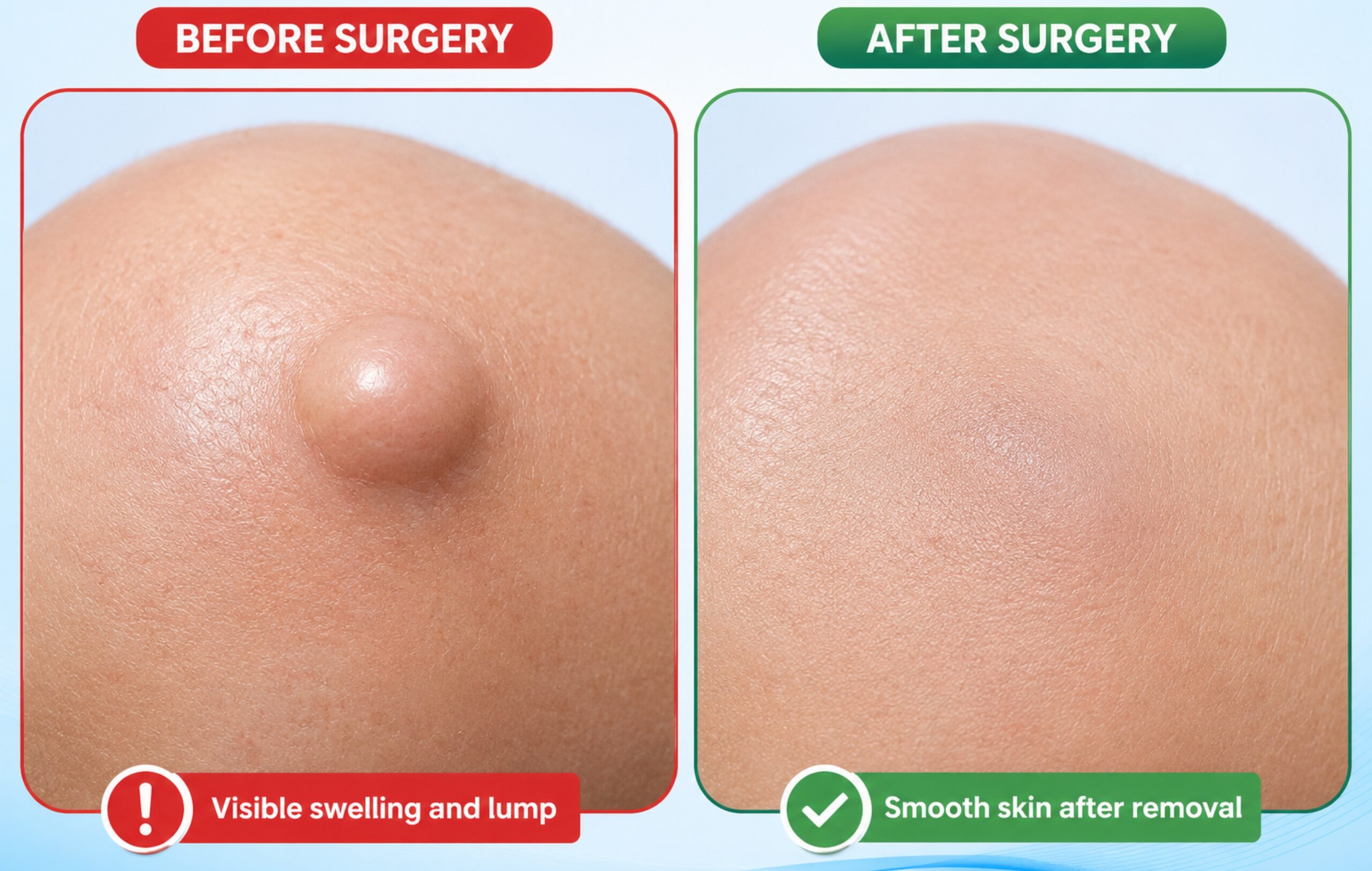
A typical ganglion cyst presenting as a smooth, round swelling near a finger joint.
Why Do Ganglion Cysts Form on the Fingers?
The exact cause of a synovium finger cyst is not always clear, but dermatologists and hand specialists associate the condition with several contributing factors. Understanding these factors helps our team plan the right ganglion cyst treatment for each patient, so it is worth recognising your own risk and seeking timely consultation.
- Joint or tendon sheath weakness: A small tear or weak spot in the joint capsule or tendon lining allows synovial fluid to herniate outward, forming a sac.
- Repetitive hand movement or strain: Activities that involve repeated gripping, typing, or fine finger movements can put mechanical stress on the small joints of the hand.
- Previous injury: A past sprain, fracture, or trauma to the finger or wrist joint can predispose the area to cyst formation later.
- Underlying joint wear (osteoarthritis): Mucous cysts near the end joint of the finger are frequently linked to early osteoarthritic changes in that joint.
- Age and gender factors: Ganglion cysts are more frequently seen in adults between 20 and 60 years, and somewhat more often in women than men.
It is important to note that a ganglion or synovium cyst is not caused by an infection and is not contagious. It is a mechanical, fluid-related swelling rather than a bacterial or fungal condition.
Symptoms of a Ganglion Cyst on the Finger
Most patients first notice the cyst as a visible or palpable lump, but the presentation can vary depending on its exact location and size. Recognising these symptoms early makes ganglion cyst treatment simpler and more effective. Common symptoms include:
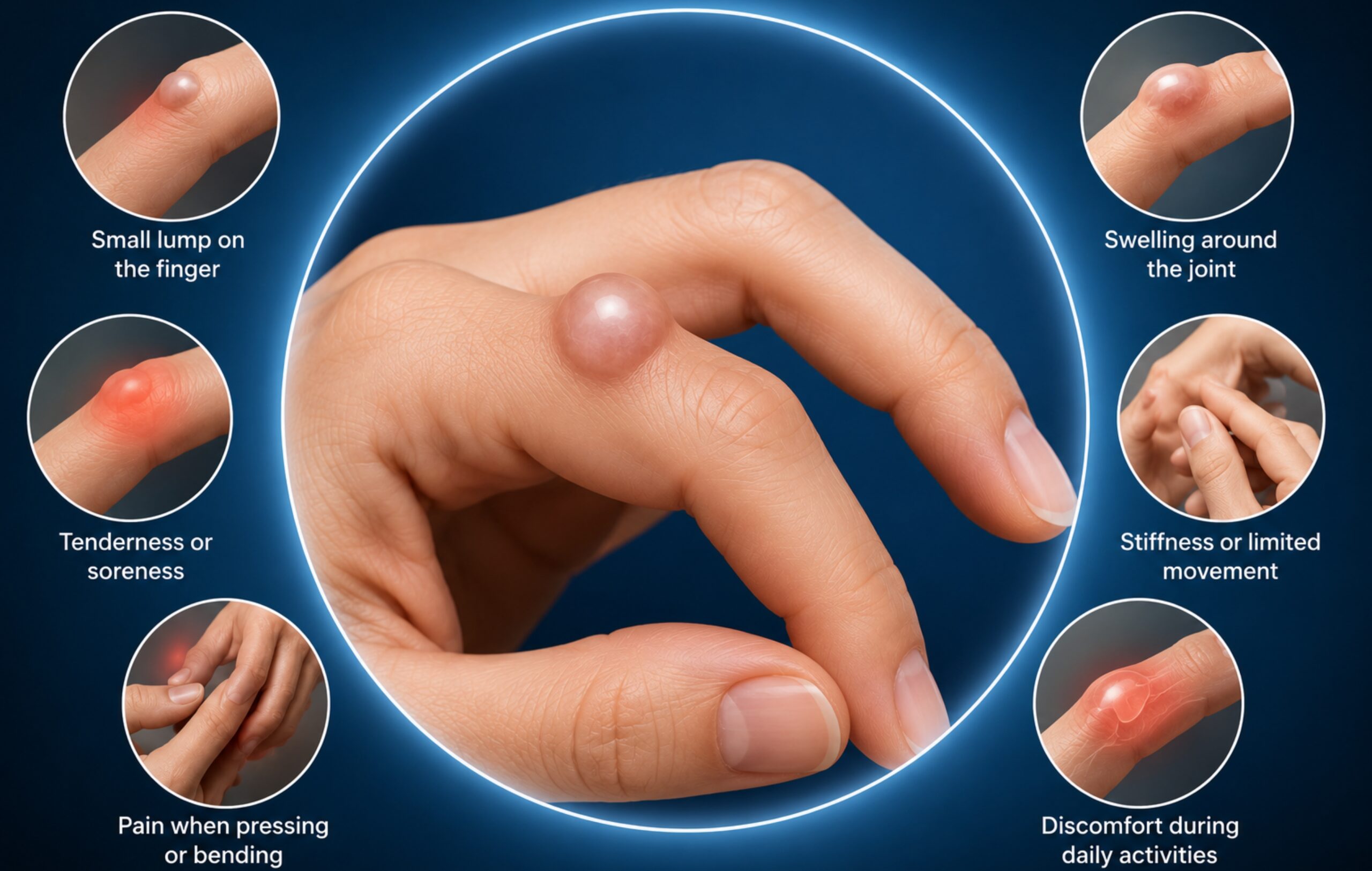
- A smooth, round, soft-to-firm swelling under the skin, usually 0.5 cm to 2.5 cm in size
- Location typically at the base of a finger, the back of the wrist, or near the last knuckle (mucous cyst)
- The lump may feel fixed to deeper tissue but movable under the skin
- Little or no pain in most cases, though some cysts can ache, especially if they press on a nearby nerve
- Size may increase with joint activity and decrease with rest
- Occasional tingling or weakness if the cyst compresses a nerve running close to the joint
- Skin over a mucous cyst near the nailbed may appear thin, shiny, or cause a ridge on the nail
Diagnosis Before Ganglion Cyst Treatment
Accurate diagnosis is the foundation of effective ganglion cyst treatment. Diagnosis usually begins with a straightforward clinical examination. Dr. Jasdeep Kaur examines the size, location, texture, and mobility of the swelling, and checks whether light passes through it (a test called transillumination), which is often positive in fluid-filled cysts. In most cases, this examination alone is sufficient to confirm a ganglion cyst.
When the diagnosis is uncertain, or if the cyst is unusually large, painful, or located near a joint with underlying arthritis, additional investigations may be recommended:
- Ultrasound: Confirms that the lump is fluid-filled rather than solid, and helps rule out other soft-tissue growths.
- Fine Needle Aspiration Cytology (FNAC): A small sample of fluid is examined to confirm the diagnosis and exclude other causes.
- X-ray: Occasionally advised if there is suspicion of associated joint changes or arthritis contributing to the cyst.

A clinical hand examination is usually enough to confirm a ganglion or synovium cyst.
Ganglion Cyst Treatment Options for the Finger
Ganglion cyst treatment is tailored to the size of the cyst, associated discomfort, and how much it interferes with daily activities or grip strength. At Skin Aura Brain & Spine Neuro Centre, the following ganglion cyst treatment options are commonly discussed with patients:
1. Observation-Based Ganglion Cyst Treatment
If the cyst is small, painless, and not affecting finger movement, the simplest approach is regular observation. A significant number of ganglion cysts shrink or disappear on their own over months without any intervention.
2. Immobilisation as Ganglion Cyst Treatment
A splint or brace may be used temporarily to rest the joint, particularly if activity is aggravating the swelling. Reduced movement can sometimes allow the cyst to shrink.
3. Needle Aspiration: A Common Ganglion Cyst Treatment
Under local anaesthesia, the thick synovial fluid is drawn out of the cyst using a fine needle, immediately reducing its size. This is a quick, minimally invasive ganglion cyst treatment that can be performed in a single clinic visit. It is important for patients to know that aspiration alone carries a chance of the cyst refilling over time, since the underlying sac is not removed.
4. Steroid Injection Ganglion Cyst Treatment
In select cases, a corticosteroid injection is given after aspiration to reduce inflammation around the cyst wall and lower the chance of recurrence.
5. Surgical Excision: Ganglion Cyst Treatment for Recurrent Cases
For larger, recurrent, or painful ganglion cysts — or those restricting finger function — complete surgical removal of the cyst along with its stalk offers the most reliable long-term ganglion cyst treatment and the lowest recurrence rate. This is performed as a minor day-care procedure under local anaesthesia, with a small, well-placed incision and minimal downtime. Our dermatology team ensures the procedure is done under sterile, professional supervision to promote fast healing and reduce scarring.
Note: Home remedies such as pressing on the cyst with a heavy object are discouraged. This outdated method can cause pain, bruising, or damage to nearby tendons and nerves without permanently resolving the cyst. A proper clinical evaluation is always the safer route.
Recovery After Ganglion Cyst Treatment
Recovery after ganglion cyst treatment by aspiration is usually quick, with most patients resuming daily activities within a day. After surgical excision, mild swelling and stiffness for a few days is normal, and patients are advised to keep the area clean and dry, avoid heavy gripping activity for one to two weeks, and attend a follow-up visit to monitor healing. Gentle finger movement exercises may be recommended to prevent stiffness while the incision heals.
When Should You See a Dermatologist in Gurgaon or Delhi NCR for a Finger Cyst?
Book a consultation for ganglion cyst treatment if the swelling on your finger or wrist is growing in size, becomes painful, restricts movement, or causes tingling or weakness. You should also see a specialist if you are simply unsure whether it is a ganglion cyst, lipoma, or another type of skin or soft-tissue swelling such as a mole, wart, or skin tag. Self-diagnosis based on internet images is not a substitute for a hands-on clinical examination, since several conditions can mimic a synovium finger cyst.
Patients from DLF Phase 4, Sector 43, Sushant Lok, South City, Golf Course Road, and other parts of Gurugram, as well as those travelling from Delhi, Noida, Faridabad, and the wider Delhi NCR region, can consult Dr. Jasdeep Kaur at Skin Aura Brain & Spine Neuro Centre for an in-person evaluation of finger, wrist, and hand cysts, with same-day aspiration or minor surgical removal available where appropriate.
Ganglion Cyst Treatment Cost & Consultation in Gurgaon, Delhi NCR
The cost of ganglion cyst treatment in Gurgaon depends on the method used — observation and follow-up cost the least, needle aspiration is moderately priced, and surgical excision costs more due to the procedure and aftercare involved. The exact ganglion cyst treatment cost also depends on the cyst’s size and location on the finger, wrist, or hand. Patients across Gurugram and the greater Delhi NCR region can get a personalised treatment plan and transparent cost estimate during an in-person consultation at Skin Aura Brain & Spine Neuro Centre, DLF Phase 4, Gurugram.
About Skin Aura Brain & Spine Neuro Centre, Gurgaon
Skin Aura Brain & Spine Neuro Centre is a dedicated dermatology and neuro-care clinic located in DLF Phase 4, Gurugram, serving patients across Gurgaon and Delhi NCR. The clinic is led by Dr. Jasdeep Kaur Malhotra (Dermatologist, MBBS, DDVL) alongside Dr. Vikas Kathuria (Neurosurgeon). With over 15 years of clinical experience, Dr. Jasdeep Kaur specialises in ganglion cyst treatment, lipoma removal, laser treatments, acne scar correction, hair restoration, and a full range of medical and cosmetic dermatology services. The clinic follows a conservative, patient-first approach. It recommends the simplest effective treatment first and reserves surgery for cases where it is genuinely needed — an approach consistently reflected in patient feedback and reviews from Gurgaon and Delhi NCR patients.
Frequently Asked Questions
Is a synovium finger cyst the same as a ganglion cyst?
Yes. “Synovium finger cyst” is a descriptive term used because the cyst forms from tissue related to the synovial lining of a joint or tendon sheath. The clinical and medical name for this swelling is a ganglion cyst.
Is a ganglion cyst on the finger dangerous or cancerous?
No. Ganglion cysts are benign, non-cancerous, fluid-filled sacs. They can occasionally cause discomfort or restrict movement, but they are not a sign of cancer.
Can a ganglion cyst go away without ganglion cyst treatment?
Yes, many small ganglion cysts shrink or resolve on their own over several months. However, larger or painful cysts, or ones affecting finger movement, usually need aspiration or surgical ganglion cyst treatment for lasting relief.
Does removing a ganglion cyst hurt?
Both aspiration and surgical excision are performed under local anaesthesia, so the procedure itself is not painful. Mild soreness or swelling for a few days afterward is normal and manageable with basic care.
Can a ganglion cyst come back after treatment?
Needle aspiration has a moderate chance of recurrence since the cyst sac remains in place. Complete surgical excision, which removes the sac and its stalk, offers the lowest recurrence rate.
Should I try to pop or press a finger cyst at home?
No. Pressing, popping, or hitting the cyst can injure nearby tendons or nerves and does not reliably remove it. A clinical evaluation and proper aspiration or excision is the safe and effective route.
Which doctor should I consult for a finger cyst in Gurgaon?
A dermatologist experienced in minor cyst and lipoma procedures, such as Dr. Jasdeep Kaur at Skin Aura Brain & Spine Neuro Centre in DLF Phase 4, Gurugram, can examine, diagnose, and treat ganglion cysts on the finger, wrist, or hand.
Is ganglion cyst treatment available near me in Delhi NCR?
Yes. Skin Aura Brain & Spine Neuro Centre in DLF Phase 4, Gurugram, treats patients from across Gurgaon, Delhi, Noida, and Faridabad, offering everything from clinical examination to needle aspiration and surgical excision for finger, wrist, and hand cysts.
For more skin and hair care guides from our dermatology team, visit our blog section, or browse our full list of treatments offered at Skin Aura Brain & Spine Neuro Centre, Gurgaon.
Book Your Ganglion Cyst Treatment Consultation Today
Skin Aura Brain & Spine Neuro Centre, H.N. 7311 (GF), Opp. Supermart-2, DLF Phase 4, Gurugram – 122002, Haryana
Call/WhatsApp: +91-8586844718 | Mon–Sat: 10:30 AM–12:30 PM & 6:00 PM–7:30 PM | Sun: 10:00 AM–2:00 PM